
Your clinic is busy. But do you know where time, money, and control are being lost?
Six signs that the problem is not your team, but the system your team is forced to work in—and how to regain visibility without making operations more complicated.

The most expensive operational problems rarely look like a crisis. They look like a normal day.
The schedule is full. Reception answers. Doctors consult. Invoices go out. From the outside, the clinic appears to be working.
But between calls, cancellations, records, messages, stock, and reporting are dozens of manual handoffs. Each one looks small. Together, they drain the team’s attention and leave management without a complete picture.
“A clinic does not become difficult to run overnight. It becomes difficult one spreadsheet, one message, and one exception at a time.”
The problem becomes visible
Six signs that operations have outgrown the current systems
You do not need to recognize all six. If two or three feel familiar, the cost of fragmentation is already appearing.
Reception has become the center of every exception
Appointments, confirmations, questions, payments, and messages reach the same people, who must remember what happens next.
The answer depends on who is asked
The information exists, but it is split across applications, conversations, sheets, and colleagues who know “how it is done.”
Reports explain the past, not today
Indicators arrive after exports and manual checks, when the opportunity to intervene has already passed.
Patient follow-up depends on memory
Confirmations, recalls, and unfinished plans are followed up when someone remembers or finds time.
Missing supplies are discovered too late
The system balance and reality drift apart, and replenishment begins only after the situation becomes urgent.
Too many decisions stop with the owner
The clinic runs, but peace of mind disappears when you are unavailable for approvals, explanations, and checks.
The real cause
You do not have a people problem. You have a system problem.
Good people compensate for weak processes for a long time. They build sheets, groups, lists, and shortcuts. That adaptation is precisely what hides the problem.
As the clinic grows, every temporary solution becomes one more place to check. The work does not disappear; it moves between applications and lands back on the team.
The useful question is not “how do we make people work faster?” but “which information can move by itself, correctly and on time?”
The solution
The clinic needs an operating system, not another application
A good system does not add steps. It connects clinical, administrative, and financial work so the team operates from the same reality.
One source of truth
Appointments, records, payments, communication, and stock should describe the same activity without manual reconciliation.
Automation around the team
The system handles confirmations, reminders, documents, and repetitive steps without hiding control from the user.
Timely visibility
Managers see what is happening now, what needs attention, and where a blocker is forming before it becomes a crisis.

The product
This is the role of BlitzClinic
BlitzClinic brings the clinic’s essential workflows into one platform built for medical operations. It does not replace the team’s judgment; it removes coordination work that should not exist.
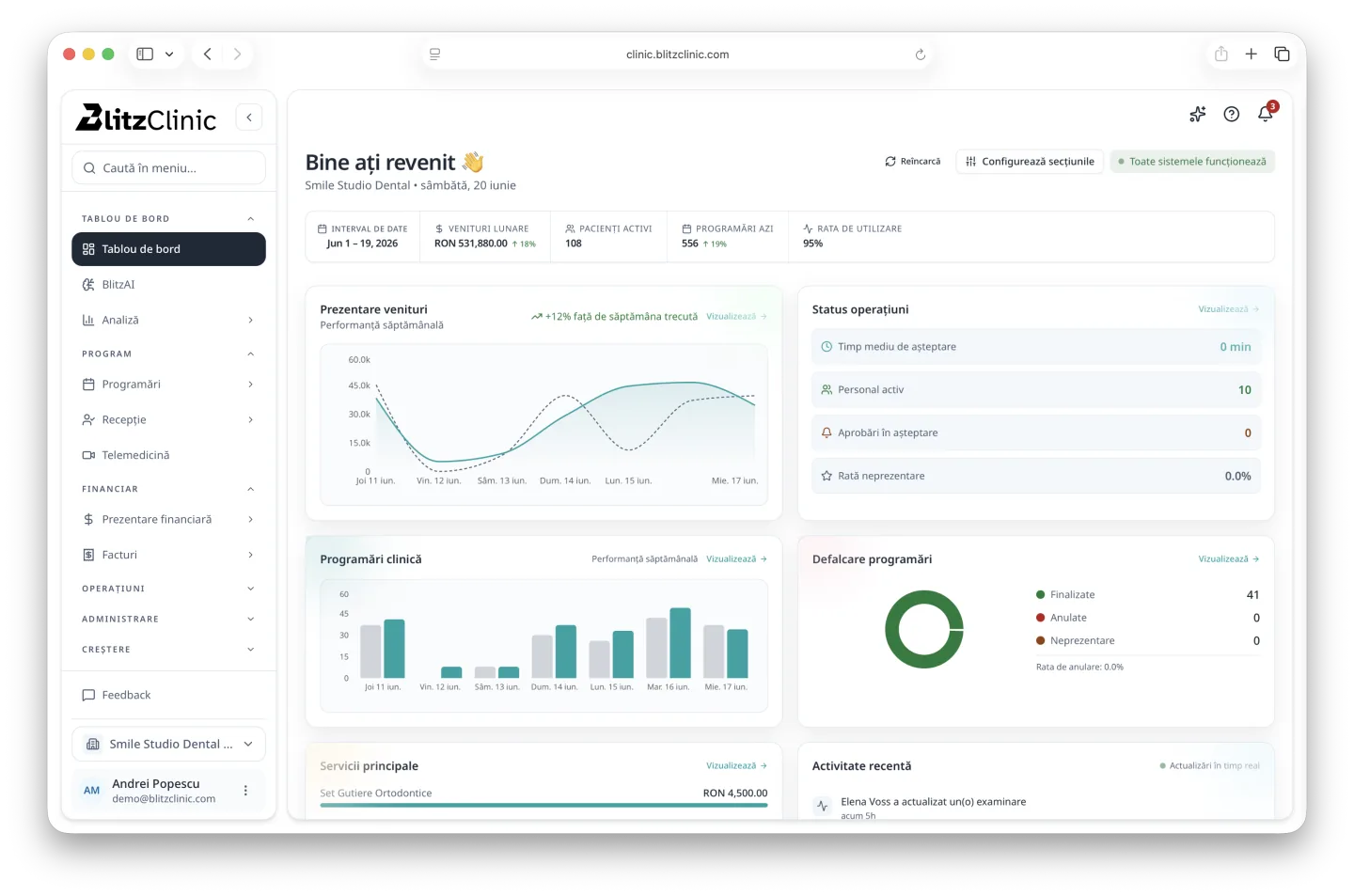
Appointments and calendar
Schedules, availability, confirmations, cancellations, and reducing idle time.
Clinical record
Records, treatment plans, forms, and documents available to the right team members.
Patient relationships
Messages, reminders, digital forms, and a portal for simpler interactions.
Payments and billing
Payments, invoices, balances, and financial tracking connected to clinic activity.
Reports and indicators
Visibility into appointments, revenue, the team, and operational performance.
Inventory and supplies
Stock movements, thresholds, traceability, and replenishment needs.
Automation and AI
Removing repetitive steps and assisting administrative work.
Access and GDPR
Roles, permissions, action auditing, and protection of sensitive information.
The moment of clarity
You may not need more work. You may need less fragmentation.
The Clinic Audit is relevant if you recognized any of these situations:
- The clinic is busy, but it is difficult to see what produces the results.
- The team searches for the same information in several places.
- Problems are addressed after they become urgent.
- Too many processes depend on one or two key people.
You do not need to choose software before the conversation. First, we establish where the problem is and what is worth changing.
How it works
No complicated scheduling in the form
You give us the context. We prepare the conversation and call you.
- 1
Complete the form
It takes about 2–3 minutes and does not ask for patient information.
- 2
We contact you
A consultant reviews your answers and calls within one business day.
- 3
Receive clear priorities
We discuss the blockers and show the BlitzClinic workflows that matter to your clinic.